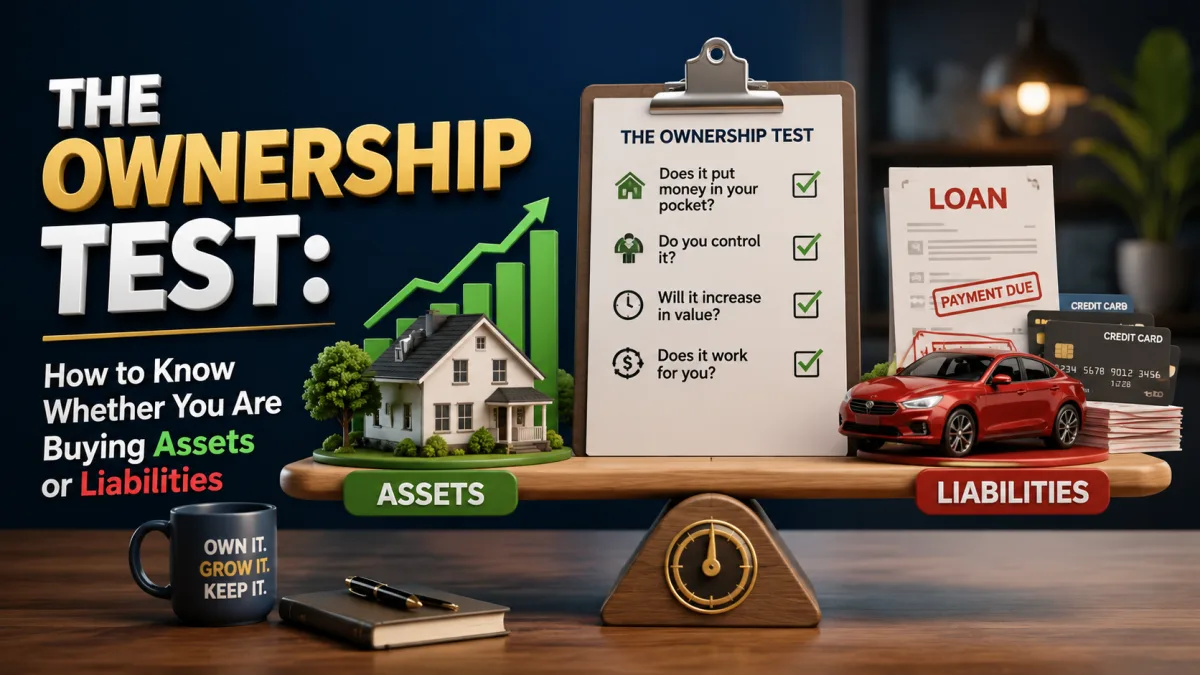
The Ownership Test: How to Know Whether You Are Buying Assets or Liabilities
Poor financial decisions often look normal.
They do not always appear reckless. They do not always involve gambling, fraud, or obvious irresponsibility. More often, they look like everyday life: a new car with a large payment, a phone upgrade financed over many months, a luxury purchase placed on a credit card, a bigger lifestyle after a raise, or a home filled with things that cost money but produce no future value.
That is why many people struggle financially even when they earn a decent income. Their problem is not always income. It is direction. Money comes in, but it does not become ownership. It becomes payments, upgrades, maintenance, interest, and depreciation.
The difference between assets and liabilities is one of the most important financial ideas a person can learn. It changes how you look at income, spending, debt, status, and long-term security. It also explains why two people can earn the same amount of money but end up in very different financial positions.
One person uses income to buy things that demand more money every month. The other uses income to buy things that can produce money, rise in value, or strengthen future earning power.
That difference compounds.
Financial freedom depends on ownership. Income pays bills, but assets create wealth. A paycheck can support your life, but ownership can expand your life. The wealthy understand this distinction deeply. They may enjoy nice things, but their financial foundation is built on assets, not appearances.
What Is an Asset?
An asset is something that can put money into your pocket, increase in value over time, produce cash flow, or strengthen your future financial position.
Assets do not all work the same way. Some produce income regularly. Some appreciate in value. Some do both. Some are financial assets, such as stocks and exchange-traded funds. Some are business assets, such as equipment, customer lists, software, or intellectual property. Some are personal assets, such as skills that increase your earning power.
The common feature is value creation.
An asset helps your money work beyond the original moment of purchase. It gives you a claim on future cash flow, ownership, productivity, or appreciation. It has the potential to make you financially stronger over time.
Examples of assets include stocks, index funds, exchange-traded funds, dividend investments, rental property, profitable businesses, intellectual property, digital products, and valuable skills. Each has different risks, requirements, and time horizons, but all can contribute to wealth when acquired intelligently.
An asset is not defined by how impressive it looks. It is defined by what it does.
What Is a Liability?
A liability is something that takes money out of your pocket, creates future payments, loses value, or weakens your financial flexibility.
Liabilities often create monthly expenses, debt payments, maintenance costs, insurance costs, storage costs, repair costs, or depreciation. Some liabilities are necessary. Everyone needs basic living expenses. A person may need transportation, housing, communication tools, clothing, and equipment for work. The issue is not that every expense is bad. The issue is confusing consumption with wealth.
A liability becomes dangerous when it is mistaken for an asset.
Credit card debt, expensive car loans, payday loans, consumer debt, luxury purchases financed with debt, and lifestyle upgrades funded by borrowed money are common examples of liabilities. They may provide temporary comfort, convenience, or status, but they usually do not make the buyer wealthier.
Many liabilities lose value quickly. A financed luxury item may be worth less tomorrow while the debt remains. A car may depreciate while the loan continues. A credit card balance may grow through interest long after the original purchase has been forgotten.
This is how ordinary spending becomes long-term pressure.
The Simple Test: Does It Make You Richer or Poorer?
Before making a major purchase, ask one question: will this make me richer or poorer?
That question is not about guilt. It is about clarity.
A purchase that makes you richer does not always produce money immediately, but it should improve your future financial position. An investment account contribution can grow over time. A course that genuinely increases your earning power may produce future income. A piece of business equipment may help you serve more customers. A rental property may produce cash flow if bought at the right price and managed well.
A purchase that makes you poorer may feel good in the moment but creates no lasting financial benefit. It may increase monthly obligations, add debt, or lose value quickly. It may also create hidden costs that continue long after the excitement fades.
The question is powerful because it cuts through appearances. A luxury car may look like success, but if it consumes too much income, depreciates quickly, and prevents investing, it may weaken the buyer’s future. A simple investment account may look boring, but if it quietly accumulates ownership year after year, it can build real wealth.
Wealth is often quiet. Liabilities often make noise.
Why Many People Stay Broke
Many people stay broke because most of their income flows into liabilities.
They earn money and immediately convert it into expenses. A raise becomes a higher car payment. A bonus becomes a vacation paid for before savings are built. A promotion becomes a larger apartment, more subscriptions, better clothes, newer devices, and more frequent dining out. Their income rises, but their ownership does not.
This pattern is common because it feels normal. Society often rewards visible consumption more than invisible wealth. People notice the car, the watch, the phone, the trip, and the clothes. They do not notice the index fund contribution, the paid-off debt, the growing emergency fund, or the ownership stake in a business.
That creates pressure to look financially successful before becoming financially secure.
The result is high income with low net worth. This is one of the most misunderstood financial conditions. A person can earn a strong salary and still feel stressed because every dollar is already committed. Their lifestyle may look impressive, but their balance sheet is fragile.
High income without assets does not create freedom. It creates dependency on continued income.
If the paycheck stops, the lifestyle is threatened. If expenses rise, stress increases. If debt payments accumulate, flexibility disappears. If no assets are being purchased, the person remains trapped in the cycle of earning and spending.
Income Is Not Wealth
Income and wealth are related, but they are not the same.
Income is money received during a period of time. Wealth is what remains and grows after money is managed. A person can have high income and low wealth if they spend everything. A person can have moderate income and rising wealth if they consistently save and invest.
This distinction matters because many people focus only on earning more. Earning more is important, but income must be directed. Without discipline, more income often creates more spending.
Wealth is built when income is converted into assets.
That conversion is the heart of financial progress. You work, earn money, keep part of it, and use that capital to acquire ownership. Over time, the assets begin to contribute. They may produce dividends, interest, business profits, rental income, royalties, or appreciation. The more assets you own, the less your financial life depends only on your labor.
This is why wealthy people think about ownership. They do not only ask, “How much can I earn?” They ask, “What can I own?”
The Wealth Formula
The wealth formula is simple: earn income, save capital, buy assets, reinvest profits, repeat.
Each step matters.
Earned income provides the raw material. Saving creates the gap between income and expenses. Buying assets turns saved money into ownership. Reinvesting profits allows growth to compound. Repeating the process over years builds financial strength.
This formula is not exciting, but it is powerful. It explains how ordinary people build extraordinary financial results over time.
The formula also explains why appearances can be misleading. Someone who spends all their income may appear wealthy today. Someone who quietly buys assets may appear ordinary today. But over time, the second person is building a machine that can produce value in the future.
Assets create more assets when profits are reinvested. Dividends can buy more shares. Business profits can fund expansion. Rental income can help acquire more property. Investment gains can compound inside a portfolio. Skills can lead to higher income, which can buy more assets.
This is how wealth begins to multiply.
Good Debt vs Bad Debt
Not all debt is equal.
Debt is a tool. Like any tool, it can build or destroy depending on how it is used. The same borrowing power that helps someone acquire an income-producing asset can also trap another person in years of consumer payments.
Good debt is often used to buy or build something that can appreciate, produce income, or expand earning power. Bad debt is usually used to fund consumption, depreciating purchases, or lifestyle upgrades that create financial pressure.
The difference is not always obvious from the outside. A loan used to buy equipment for a profitable business may be strategic. A loan used to buy luxury items for appearances may be destructive. A mortgage on an affordable rental property with positive cash flow may help build wealth. A large loan on a personal residence that stretches the buyer too thin may create stress, even if the house itself has value.
The key question is whether the debt improves or weakens your future financial position.
Good Debt
Good debt can help buy appreciating assets, produce income, expand business opportunities, or increase long-term earning potential.
Examples may include a carefully evaluated business loan, a mortgage on a cash-flowing property, education debt tied to a realistic income increase, or financing for productive equipment. Even then, debt should be used carefully. A loan is not good simply because it is attached to an asset. The numbers must work.
Good debt usually has a clear plan for repayment, reasonable terms, manageable risk, and a connection to future value creation.
Bad Debt
Bad debt funds consumption, buys depreciating items, creates financial pressure, or produces no future income.
Credit card debt for lifestyle spending is one of the clearest examples. Expensive car loans can also weaken wealth building when the payment consumes money that could have been invested. Buy-now-pay-later purchases may seem harmless, but they can train people to spend future income before it arrives.
Bad debt makes the past expensive. You continue paying for things after their value has faded.
The Car Problem: When a Liability Pretends to Be an Asset
Cars are one of the most common examples of an item people confuse with an asset.
A car can be useful. For many people, it is necessary for work, family, and daily life. But most personal vehicles are not wealth-building assets. They usually depreciate, require insurance, need maintenance, consume fuel, and may come with loan interest.
The issue is not owning a car. The issue is overbuying a car.
A person may justify an expensive vehicle by saying, “I need transportation.” That may be true. But needing transportation does not mean needing a payment that damages the ability to save and invest. A car should serve your financial life, not dominate it.
Transportation is a need. Excessive car debt is often a liability disguised as normal living.
The Home Question: Asset or Liability?
A home is more complicated.
Many people call their home an asset because it may appreciate over time and can build equity. That can be true. But a personal residence also requires mortgage payments, property taxes, insurance, repairs, maintenance, utilities, and sometimes association fees.
A home can strengthen your net worth if bought affordably, maintained wisely, and held long enough. But it can weaken your financial life if the payment is too large, the upkeep is unaffordable, or the purchase prevents investing in other assets.
The lesson is not that a home is always bad or always good. The lesson is that every purchase must be evaluated honestly.
A house you live in may be a long-term asset on your balance sheet, but it does not usually put cash into your pocket each month. A rental property that produces positive cash flow may behave differently. The numbers matter.
Wealth builders do not rely on labels. They examine cash flow, risk, cost, and future value.
Asset Examples That Build Wealth
Strong wealth-building assets tend to produce value beyond the original purchase. They may not all be appropriate for every person, but understanding them helps clarify the ownership mindset.
Index Funds and ETFs
Index funds and exchange-traded funds allow investors to own a diversified basket of securities. Instead of trying to pick one winning company, an investor can own exposure to many companies through a single fund.
This approach can be useful for long-term investors because it is simple, diversified, and often lower cost than many actively managed strategies. It also helps beginners avoid the temptation to gamble on individual stocks without proper research.
Index investing is not risk-free. Markets can decline. Values can fluctuate. But over long periods, diversified ownership has been one of the most accessible ways for ordinary people to participate in business growth.
Dividend Stocks
Dividend stocks are shares of companies that distribute part of their profits to shareholders. Dividends can provide cash flow, and reinvested dividends can help compound wealth.
However, dividend investing requires judgment. A high dividend yield is not automatically good. Sometimes a high yield signals risk. Investors should consider the company’s financial strength, payout sustainability, industry position, and long-term prospects.
The goal is not just income today. The goal is durable ownership.
Businesses
A profitable business can be one of the most powerful assets because it can produce income, build equity, and grow in value over time.
Businesses also carry risk. They require customers, operations, cash management, marketing, leadership, and resilience. Many businesses fail because the owner underestimates the complexity of producing consistent profit.
Still, business ownership teaches one of the deepest lessons in wealth building: value must be created before value can be captured. A business earns money by solving problems people are willing to pay for.
Real Estate
Real estate can build wealth through rental income, appreciation, amortization, and tax advantages depending on the location and structure. But real estate is not automatically profitable.
Bad real estate deals can become expensive liabilities. Repairs, vacancies, taxes, insurance, interest rates, tenant issues, and poor purchase prices can erase expected returns.
Real estate works best when the buyer understands the numbers: purchase price, financing cost, cash flow, maintenance, vacancy assumptions, local demand, and exit strategy.
Digital Products and Intellectual Property
Digital products and intellectual property can create income beyond direct hourly labor. Examples include courses, books, templates, software, music, designs, research tools, and educational materials.
These assets often require upfront effort and distribution. The product must solve a real problem, reach the right audience, and maintain quality. But once built, a successful digital product can sell repeatedly with lower marginal costs than many physical products.
This is why intellectual property can be powerful: it allows knowledge, creativity, or systems to become scalable value.
Skills That Increase Income
Skills are often the first assets available to someone with little money.
A person who cannot yet buy large financial assets can still build earning power. Sales, coding, accounting, design, writing, negotiation, project management, marketing, leadership, data analysis, and skilled trades can all increase income potential.
Higher income, when managed wisely, creates more capital for investing. That means skill development can be the beginning of asset ownership.
Your first asset may be your ability to earn more.
The Hidden Liability of Financial Ignorance
Financial ignorance is one of the most expensive liabilities because it affects every decision.
A person who does not understand interest may carry credit card debt without realizing how costly it is. A person who does not understand depreciation may overbuy cars. A person who does not understand investing may leave money idle for years. A person who does not understand cash flow may buy a property that looks attractive but loses money.
Education improves judgment. It helps you identify whether a purchase is building your future or consuming it.
The financially educated person does not ask only, “Can I afford the payment?” That question is too small. They ask, “What is the total cost? What is the opportunity cost? What else could this money become? Does this increase my assets or my liabilities?”
The Opportunity Cost of Liabilities
Every dollar spent on a liability has an opportunity cost. It cannot be used somewhere else.
A $500 monthly car payment is not just $500. It is $500 that cannot go into an investment account, emergency fund, business idea, or debt repayment plan. Over years, the opportunity cost may become much larger than the payment itself.
This is why wealth builders pay attention to recurring expenses. A one-time purchase can hurt, but recurring payments can quietly shape an entire financial life. The more monthly obligations you have, the less flexible you become.
Financial freedom grows when required payments shrink and asset income rises.
How Wealthy People Think About Purchases
Wealthy people are not all frugal in the same way. Some spend heavily. Some live modestly. Some enjoy luxury. But many share one important habit: they understand the difference between spending from income and spending from assets.
A person still building wealth may use earned income to buy luxury items and then have little left to invest. A wealthy person may use income produced by assets to fund lifestyle while preserving or growing the asset base.
That difference matters.
Buying luxury before assets can delay wealth. Buying assets first can eventually make luxury affordable without weakening the foundation.
The question is not, “Can wealthy people buy nice things?” Of course they can. The better question is, “What did they build before they bought them?”
The Balance Sheet Mindset
A balance sheet shows what you own and what you owe. It is one of the clearest pictures of financial reality.
Many people manage money only through monthly income. They ask whether they can make the payment. But wealth is not measured by payment ability. It is measured by net worth, cash flow, and resilience.
The balance sheet mindset asks:
What assets do I own? What liabilities do I owe? Is my net worth increasing? Are my assets producing income? Are my liabilities consuming too much cash flow? Am I buying ownership or appearances?
This mindset is powerful because it shifts focus from lifestyle to financial structure.
A person who thinks only in payments may accept a bad deal because the monthly amount seems manageable. A person who thinks in balance sheet terms sees the full effect on net worth, debt, cash flow, and future options.
How to Audit Your Spending
The simplest way to begin changing your financial future is to audit your spending through the lens of assets and liabilities.
Look at your last 30 to 90 days of spending. Do not judge yourself harshly. Study the pattern. Where did the money go? Which purchases improved your financial position? Which purchases created future payments? Which expenses were necessary? Which were habits? Which were status-driven? Which could be reduced and redirected into assets?
This exercise can be uncomfortable because it reveals the truth. But that truth is useful. You cannot change what you refuse to see.
After the audit, choose one liability to reduce. It might be a subscription, a debt balance, an unnecessary upgrade, or a spending habit. Then choose one asset to increase. It might be an investment contribution, an emergency fund, a skill-building course, or business capital.
The goal is not perfection. The goal is direction.
Turning Liabilities Into Assets
Some things that begin as expenses can become assets if used strategically.
A computer used only for entertainment is mostly a consumption item. A computer used to build a business, learn a high-income skill, or create digital products can help produce value. A car used only for status is a liability. A reliable vehicle used to reach work or operate a service business may support income. Education that does not improve earning power may be expensive. Education that produces marketable skill can become a powerful asset.
This does not mean every purchase can be justified as an investment. People often trick themselves that way. The test is results. Does the purchase create value, income, efficiency, or future opportunity? Or does it simply create a story that makes spending feel responsible?
Honesty is essential.
Why Ownership Changes Your Future
Ownership changes the direction of financial life.
When you own no assets, your financial future depends almost entirely on your ability to keep earning wages. That can work for a while, but it leaves you vulnerable. Illness, job loss, industry changes, family responsibilities, or economic downturns can disrupt income.
Assets provide a second force. They may not replace income immediately, but they begin to support you. A portfolio can grow. A business can produce profit. A rental property can generate cash flow. Intellectual property can earn royalties. Skills can command higher pay.
The more assets you own, the stronger your financial position becomes.
This is not only about becoming rich. It is about having options. Assets can provide time, flexibility, security, and the ability to make decisions without constant financial fear.
Final Thought: Income Pays Bills, Assets Create Wealth
The difference between assets and liabilities is not just an accounting idea. It is a life direction.
Liabilities consume. Assets produce. Liabilities create pressure. Assets create options. Liabilities often make life look richer in the short term. Assets make life stronger in the long term.
Most people do not stay broke because they never earn money. They stay broke because their money never becomes ownership.
The path forward is simple, but it requires discipline: earn income, save capital, buy assets, reinvest profits, and repeat. Use earned income to acquire things that can produce value beyond your labor. Reduce the purchases that drain cash flow without building your future.
Every financial decision can be tested with one question: asset or liability?
Ask it before you buy. Ask it before you borrow. Ask it before you upgrade. Ask it before you commit future income.
Financial freedom depends on ownership. The more assets you own, the stronger your financial position becomes.
Income pays bills. Assets create wealth.
Audit your spending today and ask yourself one question: asset or liability?

